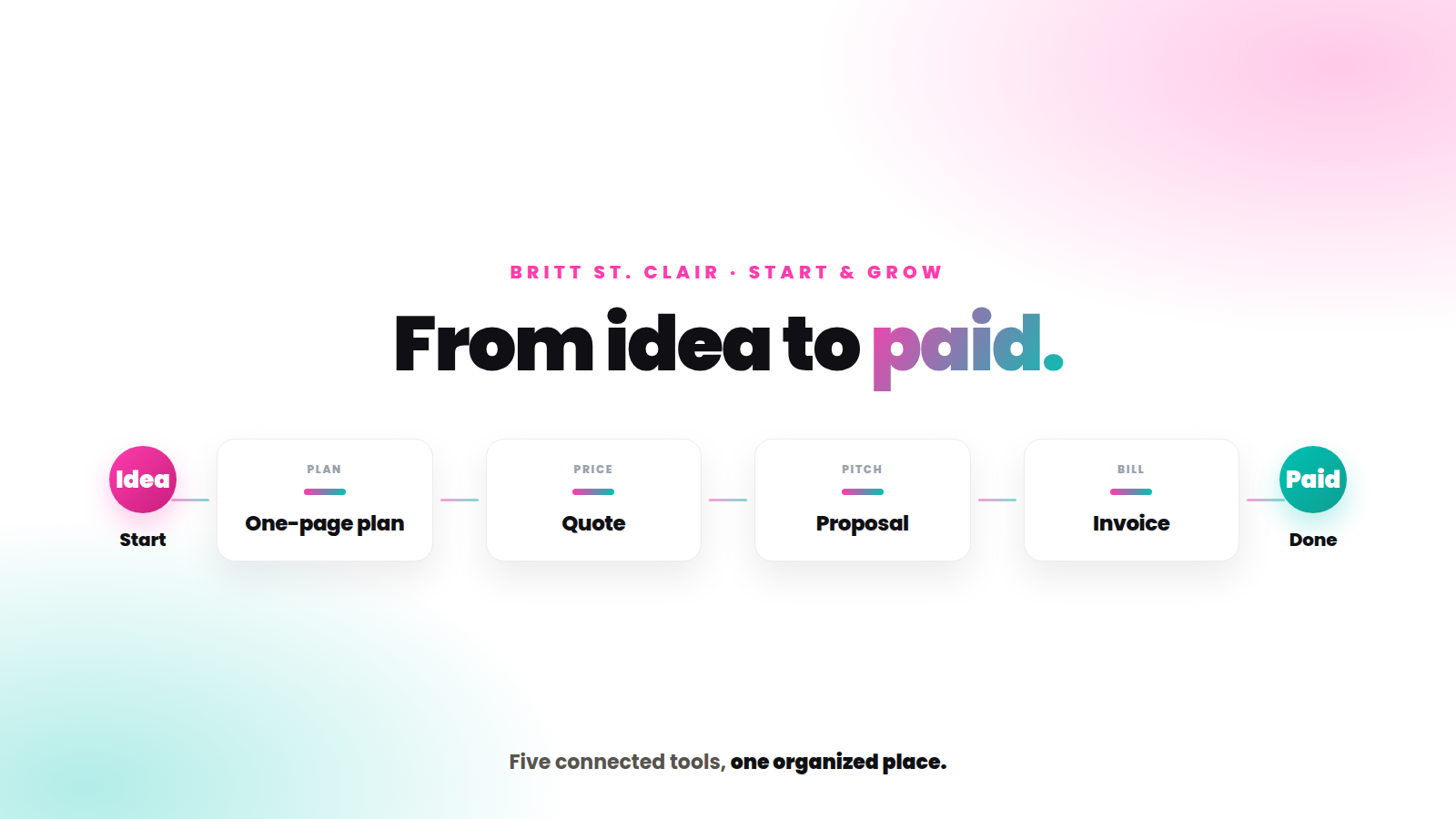
A record number of people are betting on themselves. More than 5.6 million new business applications were filed in the U.S. in 2025 (Finder, citing Census data). The idea is rarely the hard part. The hard part is the messy middle between “I want to do this” and “someone just paid me.”
Getting paid is usually where it stalls. About 56 percent of small businesses are owed money on unpaid invoices, an average of 17,500 dollars each (Clockify, citing Intuit QuickBooks). Most of that is not bad luck. It is a missing system: no clear offer, no price written down, no clean way to say “here is what it costs, here is how you pay me.”
So if you are sitting with an idea and a blank document, the real obstacle is not motivation. It is that you keep pulling each piece from a different place: pricing tips from one video, a proposal template from a random site, an invoice app that has no idea what your proposal promised. The parts never talk to each other. Build them as one connected set, in the right order, and “idea” turns into “paid.”
1. Nail the one thing you sell
Start smaller than feels comfortable. Pick one offer you can say in a sentence: who it is for, what they get, and the result. “I help new salon owners set up online booking in a week” beats “I do marketing.” A one-page plan keeps you honest here. Write the offer, the person, and the price on a single page, and you instantly sound like someone who knows what they are doing. If you want to see the kind of small, single-file tools I build for exactly this, here are the tools I made for small business owners.
2. Price it so you actually profit
Most first-timers undercharge, then quietly resent it. Your price has to cover your time, your costs, and a little room to breathe, not just match what feels “nice.” Decide your number before the conversation, not during it. When you can quote a clear figure without flinching, clients trust you more, not less. A simple quote-and-profit worksheet does the math so you stop guessing.
3. Make it easy to say yes
A proposal is not paperwork. It is you removing doubt. Keep it to one page: the problem, what you will do, the price, and the timeline. Spell out exactly what is included so there are no surprises later. People say yes faster when the next step is obvious and the scope is clear. You are not asking permission. You are handing them a simple decision.
4. Get the yes in writing
A short agreement protects the relationship, not just you. It does not need legal jargon. It needs the scope, the price, the timeline, and how changes are handled. This is what keeps a “quick favor” from turning into three weeks of unpaid extras. Clients respect it. It signals you have done this before, even on your first one.
5. Send the invoice and actually get paid
This is the step people freeze on, and it is the whole point. Send the invoice the moment the work or the deposit milestone is agreed, not weeks later. Put the due date in bold, add a payment link, and make paying you a two-tap job. The faster and cleaner your invoice, the faster the money lands. Getting paid is a system, not a confrontation.
The Challenges of Landing Your First Paying Client
Knowing the steps is not the same as doing them without second-guessing. A few real obstacles trip up almost everyone:
- Pricing fear. You worry a real number will scare people off, so you lowball and burn out.
- Scattered everything. Your plan, price, proposal, and invoice live in five different tools that do not talk to each other, so nothing matches and nothing carries over.
- Chasing payment. Without a clear invoice and due date, “I will send it over” becomes a month of silence.
- Scope creep. No written agreement, and one project quietly becomes three.
- Plain overwhelm. Building a plan, price, proposal, contract, and invoice from scratch is a lot while you are also doing the actual work.
None of these mean you are not ready. They mean the system is missing, not the talent.
How to Put Your Idea-to-Paid System to Work
Pick the step you are stuck on and start there. If the offer is fuzzy, write the one-page plan first. If clients go quiet, it is usually the proposal or the invoice. You do not need all five perfect on day one. You need them to exist, in order, and ideally in one place so each piece feeds the next. Keep them connected, build each once, reuse them on every client, and the messy middle stops being messy. If you would rather hand the marketing side off entirely, here is how I help small businesses do exactly that.
This is the whole reason I built the Business Owner’s Bundle: not five more random downloads, but one connected set. The one-page plan, the 30-day launch checklist, and the quote, proposal, and invoice tools, organized into “Plan” and “Get Paid” folders, all in one place that actually fits together. It is the whole loop, from idea to paid, instead of ten browser tabs that do not know each other exist.
Frequently Asked Questions (FAQs)
How do I get my first client with no experience?
Lead with a clear, narrow offer and a little proof you can deliver, like a sample or a free mini-version. People hire certainty, not a resume. Start with your existing network, and one small paid project builds the experience you were missing.
How much should I charge my first client?
Set a price that covers your time, your costs, and a margin, not just what feels comfortable. Decide the number before the call so you can say it without flinching. A clear, confident price builds trust faster than a cheap one.
Do I need a contract for my first client?
Yes, a short one. It does not need legal jargon, just the scope, price, timeline, and how changes are handled. A simple written agreement prevents scope creep and signals you take the work seriously.
How do I invoice my first client?
Send a clean invoice as soon as the work is agreed, with the amount, a bold due date, and a payment link. Make paying you a two-tap action. The simpler the invoice, the faster you get paid.
How long does it take to get your first paying client?
It depends on your offer and your network, but with a clear offer and a simple proposal you can land one in days or weeks, not months. The bottleneck is usually a fuzzy offer or a missing way to say yes, not time.